Aphantasia and the Invisible Image: An Inquiry into Imagination & Practical Exercises
- Apr 12
- 7 min read
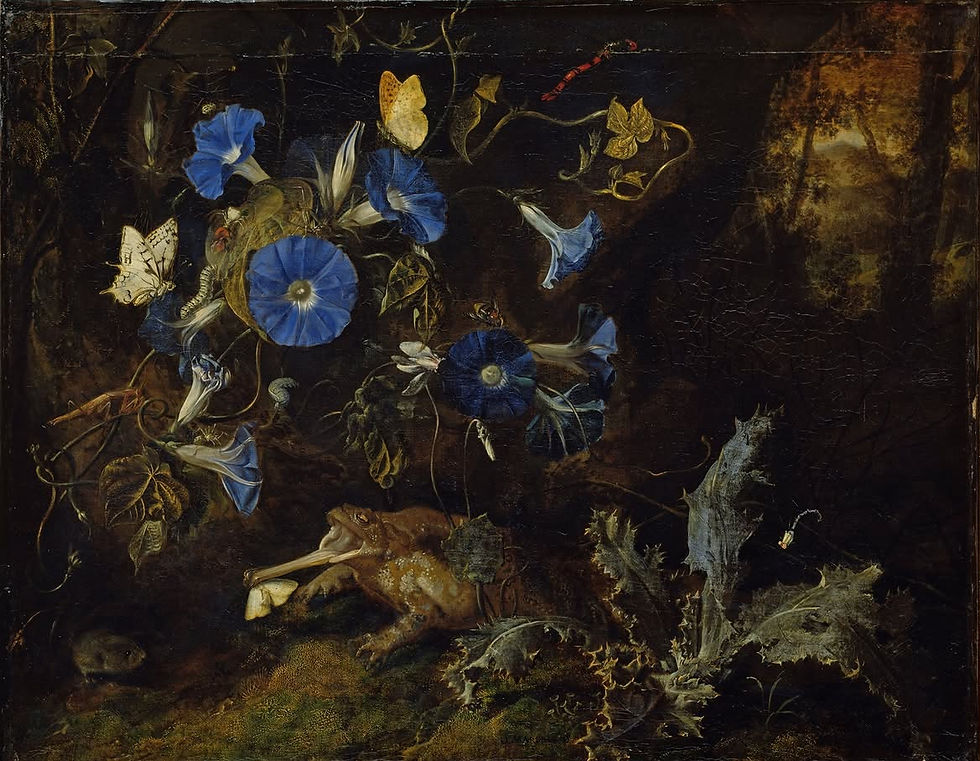
Picture: Forest Still Life with Great Morning Glory and Toad by the Dutch Golden Age artist Otto Marseus van Schrieck. Circa 1660
Aphantasia, the reported absence of voluntary mental imagery, presents a paradox - how can one know an image without ever seeing it inwardly? First described in modern clinical terms by Adam Zeman (2015) aphantasia challenges the long-standing assumption that imagination is inherently pictorial yet from a deeper psychological perspective particularly one influenced by Jungian thought this condition may signify transformation in how the psyche relates to images.
At the psychobiological level current research suggests that aphantasia reflects differences in top-down processing where higher cortical regions fail to sufficiently activate the visual cortex during acts of imagination (Pearson, 2019). In individuals with typical imagery the mere thought of an object can stimulate visual regions in a manner similar to perception (Kosslyn et al., 2001). Those with aphantasia appear to rely more heavily on conceptual and semantic systems consistent with the functioning of semantic memory rather than sensory simulation (Milton et al., 2021). This implies that imagery is not totally absent at the neural level but it may remain inaccessible to conscious awareness. This interpretation is reinforced by evidence that many individuals with aphantasia experience imagery during dreams or in hypnagogic states (Zeman et al., 2015) and such phenomena suggest that the psyche retains the capacity for image generation particularly under conditions where conscious control is diminished. From a Jungian standpoint the image is not merely a product of will but an autonomous expression of the unconscious. The inability to summon images voluntarily may therefore indicate a reconfiguration of the relationship between ego and unconscious content.
Attempts to ‘train’ visualisation increases this tension - practices such as afterimage training, guided visualisation, memory reconstruction, image streaming and hypnagogic observation are often proposed as methods to cultivate imagery. Afterimage training grounded in the persistence of iconic memory seeks to extend the fleeting sensory trace that follows perception. The idea is to strengthen the link between perception and imagery. Some support for this comes from research into iconic memory which shows that the brain naturally retains a short-lived visual trace after seeing something (Kosslyn et al., 2001). Which suggests there is at least a sensory foothold that can be trained or extended.
Practice: Sit with a simple high-contrast object (like a coloured square) and stare at it for 15-20 seconds then close your eyes and try to hold onto the fading imprint. Repeat this several times noticing even the faintest residual shapes or colours not expecting a clear picture.
Guided visualisation encourages engagement with non-visual sensory modalities aligning with broader theories of mental imagery as a multisensory phenomenon which is not a purely visual one (Pearson, 2019). Many people with aphantasia report no visual change but some find their mental experience becomes richer in other sensory ways. Research indicates that even without visual imagery people can activate similar brain networks using non-visual imagination (Pearson, 2019) suggesting this approach may strengthen adjacent systems even if visuals do not appear.
Practise: Listen to a script describing a scene such as walking along a beach, focus first on sounds, textures and temperature letting any imagery arise passively.
Memory reconstruction exercises which emphasise the deliberate assembly of conceptual features appear to be more effective in enhancing functional cognition. These methods leverage the strengths of semantic processing allowing individuals to navigate the world without reliance on internal pictures (Milton et al., 2021). This method is supported by findings in semantic memory which show that people can represent objects conceptually without visual imagery (Milton et al., 2021) and individuals with aphantasia rely more heavily on these semantic strategies indicating this exercise builds on an already functional system rather than trying to create a new one from scratch.
Practise: Instead of trying to ‘see an object list its properties such as shape, colour, size, orientation and mentally piece them together step by step. Over time you try to compress this process into something more immediate.
Image streaming attempts to bypass conscious inhibition through continuous verbalisation potentially engaging the brain’s spontaneous thought systems. However empirical support for its efficacy is limited. The goal is to reduce internal inhibition and allow spontaneous imagery to surface. This technique loosely connects to research on the default mode network which is involved in mind-wandering and internal experiences (Carhart-Harris & Friston, 2019) the idea being that by keeping the brain in a flowing, unstructured state you may increase the chance of involuntary imagery appearing.
Practise: Speak continuously about whatever comes to mind describing even vague impressions, abstract thoughts or fleeting sensations without filtering or pausing.
Among these practices, hypnagogic observation is extremely interesting - the transitional state between wakefulness and sleep known as hypnagogia is characterised by vivid and involuntary imagery. Reports from individuals with aphantasia suggest that this state may provide rare access to visual experience (Zeman et al., 2015; Milton et al., 2021). Psychobiologically this may reflect a shift from top-down to bottom-up processing where sensory regions become active independently of executive control (Pearson, 2019). Some people who otherwise report no mental imagery say this is the only time they experience visuals. This is supported by research into hypnagogia where vivid and involuntary imagery is common even in individuals who lack strong waking visualisation (Pearson, 2019) suggesting that the brain is capable of generating images but that voluntary access to them may be what differs in aphantasia.
Practise: As you fall asleep pay close attention to fleeting shapes, flashes or scenes that may arise trying to observe them without fully waking up.
This theme becomes even more interesting in the study of altered states of consciousness particularly those induced by meditation and psychedelics. Meditative practices that reduce cognitive control and enhance attentional openness have been associated with increased vividness of internal experience (Lutz et al., 2008) techniques such as focused attention, open monitoring and visualisation-based contemplations may gradually alter the balance between executive and sensory networks. Substances such as psilocybin and LSD have been shown to increase activity in visual cortical areas and to disrupt the hierarchical organisation of brain networks (Carhart-Harris & Friston, 2019). Under these conditions individuals frequently report intense visual imagery even in the absence of external stimuli. There are reports of individuals with aphantasia experiencing vivid imagery during psychedelic states which suggests that the neural machinery for imagery may remain intact but is ordinarily constrained by top-down regulatory mechanisms (Carhart-Harris & Friston, 2019). Psychedelics relax these constraints allowing for increased bottom-up signalling and cross-network communication which aligns with models of the brain as a predictive system in which perception and imagination arise from the interplay of prior expectations and sensory input (Carhart-Harris & Friston, 2019). By reducing the precision of top-down predictions psychedelics may permit latent imagery to emerge into consciousness.
Yet such states also raise interesting questions - if imagery can be induced pharmacologically or accessed in altered states does this imply that aphantasia is merely a blockage to be overcome or does it instead reflect a stable mode of being with its own psychological integrity? Jung cautioned against the uncritical pursuit of images emphasising the importance of integration over mere experience. The psyche deprived of visual form may express itself better through language, structure, emotion or intuition where the ‘image’ may become more abstract. Exercises aimed at cultivating imagery hold value as explorations of the boundaries between perception, thought and unconscious life.
Another perspective emerges when considering the role of language in shaping and revealing inner experience - in everyday speech people frequently use visually grounded expressions such as ‘I see what you mean’ or ‘that looks like a good idea’ even when referring to abstract or non-visual concepts. From a cognitive linguistic standpoint this aligns with theories of cognitive linguistics which propose that language is deeply rooted in embodied experience (Pearson, 2019). Visual metaphors dominate many languages suggesting that sight functions as a primary way for understanding. One interpretation is that such phrases reflect an underlying tendency to structure thought in image-like terms even when no literal image is present but of course the existence of aphantasia complicates this assumption - individuals without voluntary imagery still use the same visual language fluently implying that these expressions may operate at a conceptual rather than perceptual level. In other words, saying something is ‘seen as’ may require a shared metaphorical framework grounded in collective human experience. From a Jungian perspective this could be understood as the persistence of the ‘image’ in symbolic form - even when not consciously visualised it continues to organise meaning through language therefore linguistic habits may point to a deeper and more abstract imaginal structure that shapes cognition across individuals regardless of their perceived capacity for visual representation.
Some philosophers and researchers argue that individuals may possess latent imagery that does not rise to conscious awareness suggesting a distinction between imagery itself and metacognitive access to it (Pearson, 2019; Milton et al., 2021). This concern is compounded by the heavy reliance on subjective measures such as the Vividness of Visual Imagery Questionnaire (Zeman et al., 2015) which may be influenced by interpretation, expectation and individual differences in reporting. Individuals identifying as aphantasic often perform comparably or occasionally even better on tasks typically assumed to require imagery implying the use of alternative cognitive strategies such as verbal or spatial encoding (Milton et al., 2021). Also variability within aphantasia such as the presence of involuntary imagery in dreams but not in waking life indicates that it is not a uniform condition but a spectrum of differing experiences (Zeman et al., 2015; Milton et al., 2021) which has led some scholars to challenge the assumption that imagery is fundamentally perceptual in nature proposing instead that it may represent a distinct mode of cognition.
Together these perspectives suggest that the capacity for imagery may be differently organised for some and the question remains how to understand the many forms that imagination can take.
References
Carhart-Harris, R. L., & Friston, K. J. (2019). REBUS and the anarchic brain: Toward a unified model of the brain action of psychedelics. Pharmacological Reviews, 71(3), 316-344.
Lutz, A., Slagter, H. A., Dunne, J. D., & Davidson, R. J. (2008). Attention regulation and monitoring in meditation. Trends in Cognitive Sciences, 12(4), 163-169.
Jung, C. G. (1969). The archetypes and the collective unconscious (2nd ed., R. F. C. Hull, Trans.). Princeton University Press.
Kosslyn, S. M., Ganis, G., & Thompson, W. L. (2001). Neural foundations of imagery. Nature Reviews Neuroscience, 2(9), 635 - 642.
Milton, F., Fulford, J., Dance, C., Gaddum, J., Heuerman -Williamson, B., Jones, K., Knight, K. F., MacKisack, M., Winlove, C., & Zeman, A. (2021). Behavioral and neural signatures of visual imagery vividness extremes: Aphantasia versus hyperphantasia. Cerebral Cortex Communications, 2(2), 1-15.
Pearson, J. (2019). The human imagination: The cognitive neuroscience of visual mental imagery. Nature Reviews Neuroscience, 20(10), 624-634.
Zeman, A., Dewar, M., & Della Sala, S. (2015). Lives without imagery - Congenital aphantasia. Cortex, 73, 378-380.


Comments