Chaos & Pattern: A Mental Health Cosmology
- Nov 10, 2025
- 3 min read

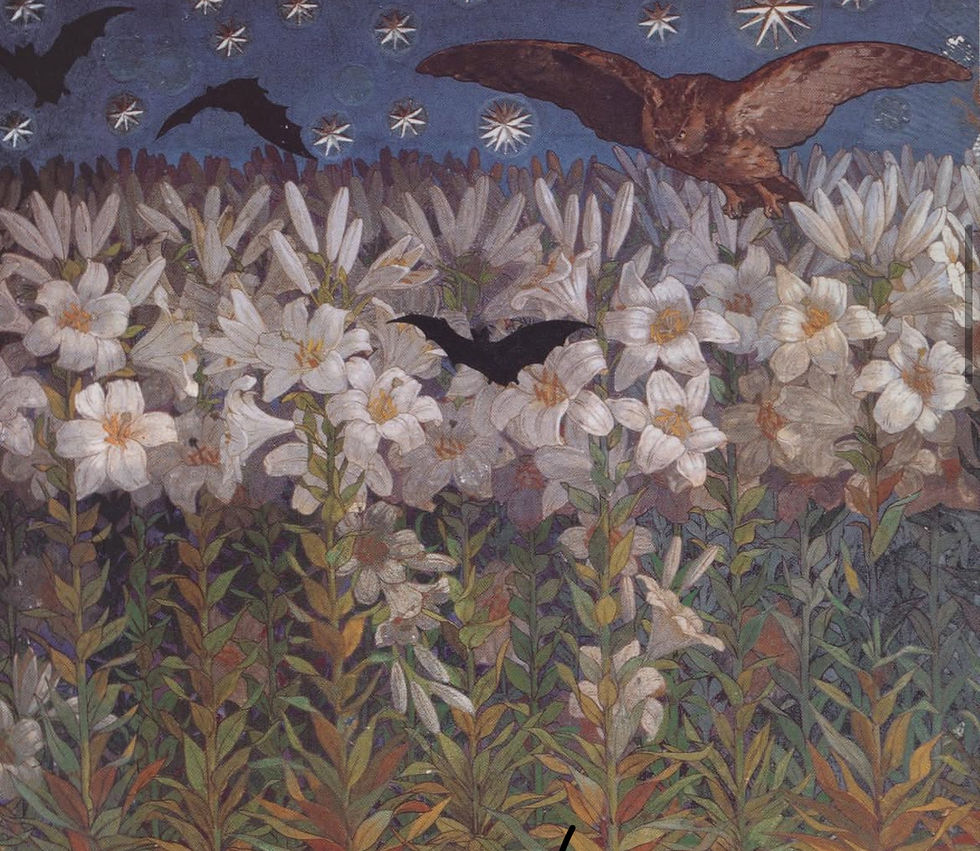
Image: Detail from a panel depicting a Nursing Madonna by the Master of the Embroidered Foliage (Netherlandish, active Brussels, late 15th century)
Why do snowflakes form such intricate, symmetrical patterns, while a single butterfly flapping its wings might one day help trigger a tornado on the other side of the world? At first glance, these phenomena seem unrelated - one suggests delicacy and order, the other - disruption. But both reveal something profound: that small movements, quiet repetitions, and local interactions can shape the whole. That seemingly insignificant beginnings can evolve into something vast, unpredictable, and alive. This isn’t just the language of science. It’s also the language of the psyche.
Here’s a simple way to think about it - self-organisation is when order arises naturally, from the bottom up - like how birds fly in coordinated patterns without anyone leading, or how traffic sometimes flows smoothly without lights or signs (Camazine et al., 2003). It means that patterns do not always need a plan - they can grow from small, repeated interactions. The butterfly effect, meanwhile, reminds us that tiny actions - like a butterfly flapping its wings - can set off a chain of events that eventually change everything (Lorenz, 1963). Dynamic systems often involve feedback, where outputs influence future behaviour, either amplifying change (positive feedback) or promoting stability (negative feedback) (Meadows, 2008). These interactions tend to pull the system toward an attractor - a stable pattern or state it naturally gravitates toward, like a recurring habit or rhythm. In our lives, this might look like a kind word that shifts your whole day, or a single insight that slowly transforms your habits. Both ideas show how small things matter - not in a dramatic and instant way, but in how they echo and evolve over time.
Self-organisation is the process by which systems - galaxies, forests, the human nervous system - form patterns from within, without any centralised control (Camazine et al., 2003). There’s no conductor, no blueprint being followed. Instead, patterns emerge through countless small interactions that respond to one another, again and again, over time. This is how starlings flock, how cells become organs, how a forest regrows after a fire. And it’s how a person, stumbling through confusion or pain, slowly begins to find rhythm again - sometimes without even realising it.
The butterfly effect, in contrast, speaks to the deep sensitivity of complex systems. This has been shown in models like the Lorenz attractor and observed in real systems such as weather patterns and population dynamics, where predictability quickly breaks down despite precise underlying rules (Lorenz, 1963; Gleick, 1987). A tiny, almost imperceptible shift in initial conditions can cascade and amplify until it transforms the whole. A fragment of memory returning during a walk. A pause before reacting. In a system as delicate as the human mind, these subtle events can echo across time, shaping emotion, thought, and behaviour in ways we rarely trace back to their origin.
At first, chaos and self-organisation might seem like opposites. Chaos appears as disorder, unpredictability, the breakdown of systems. Self-organisation implies the opposite - structure, coherence, integration. But in truth, they are interdependent. Many of the most beautiful and resilient patterns emerge precisely at the edge of chaos (Waldrop, 1992). In chemistry, in biology, in psychology, the richest transformations arise in the space where uncertainty meets the possibility of new form.
In the natural world, we see this in chemical reactions that produce spirals and waves from random movement (Turing, 1952). We see it in sand dunes sculpted by shifting winds, and in the formation of zebra stripes - not dictated from above, but born from feedback, instability, and repetition. The human mind is not so different. Thoughts spiral. Moods shift like weather. Habits form and dissolve. And sometimes, from the most chaotic internal landscapes, something startlingly coherent begins to emerge.
References
Camazine, S., Deneubourg, J. L., Franks, N. R., Sneyd, J., Theraulaz, G., & Bonabeau, E. (2003). Self-organization in biological systems. Princeton University Press.
Gleick, J. (1987). Chaos: Making a new science. Viking.
Lorenz, E. N. (1963). Deterministic nonperiodic flow. Journal of the Atmospheric Sciences, 20(2), 130–141.
Mandelbrot, B. B. (1982). The fractal geometry of nature. W. H. Freeman and Company.
Meadows, D. H. (2008). Thinking in systems: A primer. Chelsea Green Publishing.
Turing, A. M. (1952). The chemical basis of morphogenesis. Philosophical Transactions of the Royal Society of London. Series B, Biological Sciences, 237(641), 37–72. https://doi.org/10.1098/rstb.1952.0012
Waldrop, M. M. (1992). Complexity: The emerging science at the edge of order and chaos. Simon & Schuster.
Wolfram, S. (2002). A new kind of science. Wolfram Media.


Comments