Rethinking Feelings: Emotions, Culture and Collective Memory
- Nov 10, 2025
- 6 min read
Updated: May 20

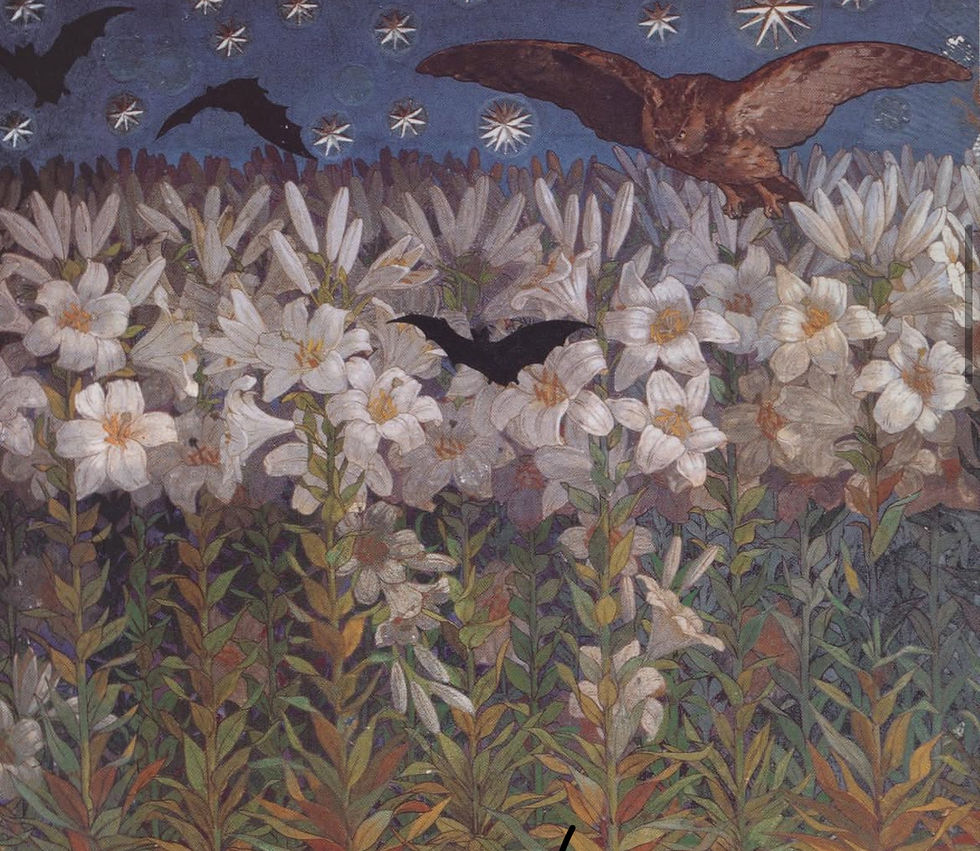
Picture: Leonora Carrington, Bird Pong, 1949
Lisa Feldman Barrett’s book How Emotions Are Made presents a transformative view - emotions are not universal biologically hard-wired responses but are constructed by the brain using concepts learned through culture and experience (Barrett, 2017). This challenges the traditional idea that emotions are innate modules instead proposing that the brain predicts and categorises bodily sensations by drawing on a library of concepts shaped by personal and cultural history. Through repeated exposure to language and social cues individuals learn to make sense of their internal states. In Barrett’s view every emotion is a kind of micro-historical event. When you feel ‘guilt’, your brain is drawing on a deeply encoded pattern built from your upbringing, the emotional language of your community and the values you have internalised over time. These patterns are updated and maintained in the shared cultural space between people.
We do not just teach our children to name emotions, we expose them to emotional templates shaped by generations. ‘Shame’ for instance may not be a singular emotion with fixed biological roots but a field-like structure that persists through repeated enactment - parents modelling it, stories and institutions reinforcing it. Over time it begins to feel natural and inevitable. But it is constructed and inherited.
This idea begins to echo the spirit of Rupert Sheldrake’s concept of morphic resonance. In Sheldrake’s view habits and patterns do not just evolve biologically or emerge through isolated learning they persist through resonance with prior similar systems. Every time an oak leaf grows it does so in resonance with all similar actions before it. His hypothesis proposes that this happens through morphic fields - forms of memory inherent in nature. Sheldrake proposes that natural systems inherit collective memory through morphic fields, non-material structures that store information from past forms and behaviours which then influence present patterns (Sheldrake, 2012). This idea offers a lens for understanding how habits, patterns and structures may persist across generations.
So, what if we consider emotion in a similar light? Under this lens, emotions may not only be shaped by culture in the sociological sense but also by something akin to an emotional field formed by generations of people repeatedly constructing and experiencing emotional states in similar ways. Just as Sheldrake suggests that once a pattern emerges it becomes more likely to reoccur, perhaps emotional concepts once formed and repeatedly enacted become more available for others to access and embody which then shapes the emotional landscape of generations to come offering a direction that is influenced and determined by the past.
Both theories centre around the idea of inherited patterning. For Barrett emotional concepts are culturally transmitted - language, social norms and education shape how individuals come to categorise and experience affective states. The brain is a prediction engine constantly using past experiences to interpret and prepare for what comes next. Concepts play a vital role in this process by providing the building blocks through which the brain interprets sensory input and constructs emotion. For Sheldrake morphic resonance implies that memory is not stored only in the brain but in morphic fields that extend across time and space allowing organisms to tap into collective patterns without needing direct contact.
The overlap between these views lies in their shared emphasis on the transmission of pattern - Barrett’s framework explains this transmission through neural networks, prediction and interoception and Sheldrake offers a different model of resonance across morphic fields. Exploring these parallels encourages a deeper reflection on how emotional life is shaped. The human capacity to feel is a social and historical one rooted in the stories, languages and relationships.
We already speak of ‘emotional atmospheres’, group-level affective states that feel contagious like grief in a mourning crowd or euphoria at a gig. Barrett’s framework offers one explanation - brains in similar contexts make similar predictions, interpret bodily states with shared conceptual tools and thus converge on similar constructed experiences. But if we push this idea further we might ask - could these collective states, especially those formed repeatedly over time, take on a kind of enduring shape in the human emotional landscape?
A central implication of Barrett’s work is that our emotional vocabulary directly shapes our capacity to perceive, regulate and communicate our internal states. In essence,the words we have access to not only describe emotions but also help construct them. Without a concept like ‘resentment’ a person may feel the physiological or situational ingredients of those emotions but remain unable to identify or act upon them meaningfully which has profound consequences for self-awareness and relational depth. My own hypothesis builds on this idea - expanding someone’s emotional vocabulary, for instance, by offering them a curated list of emotion words with clear, accessible descriptions - we can support the development of emotional granularity over time. The CSTP (Carleton Skills Training Program) supports the idea that teaching emotional vocabulary and helping people differentiate feelings can improve their ability to connect with themselves and others.
Just as naming a colour brings it more vividly into perceptual awareness, naming an emotion enables the brain to recognise and regulate it better. In this sense an increasing vocabulary becomes a kind of internal tuning allowing people to connect more clearly to themselves and more empathetically to others.
Carl Jung’s theory of the collective unconscious offers another perspective on how emotional patterns might be transmitted across generations. Jung proposed that beneath the personal unconscious lies a deeper layer - a shared psychic inheritance composed of archetypes and universal symbols common to all human beings (Jung, 1968). These archetypes such as the Mother, the Shadow or the Hero emerge spontaneously in dreams, myths and emotional life across cultures. Jung’s notion of collective memory resonates with the idea that emotional and psychological patterns can persist and shape individuals through symbolic, cultural and perhaps even biological channels. When placed alongside Barrett’s theory of emotion as a construction shaped by cultural and conceptual exposure, Jung’s collective unconscious suggests that the emotional layer we inherit is not only linguistic or behavioural but also symbolic and imaginal. Both views imply that we are embedded in larger emotional fields of meaning and feeling that extend beyond personal experience and guide how we interpret and respond to life.
Barrett’s model is rooted in neural networks and prediction loops. The idea of morphic resonance allows us to deepen our appreciation of how emotional life is shaped not only by immediate environments but by vast, accumulated cultural patterns which persist most strongly when repeated. Although Barrett and Sheldrake operate within very different epistemological frameworks their work converges on a compelling insight - what we feel is not simply inside us but around us transmitted and reinforced through the structures, be it scientific or symbolic, that bind one generation to the next. Both Barrett and Sheldrake offer stories about how the past informs the present, Barrett through brain-based predictions and Sheldrake through resonance with collective memory and each in its own way invites us to see ourselves as receivers and transmitters of emotional patterns that began long before us. And Carl Jung’s idea of the collective unconscious proposes that the emotional and symbolic architecture of human life is shaped by patterns hinting at a kind of psychological inheritance encoded in myths, archetypes and shared human experience. Together these ideas suggest that emotion is transmitted across generations and cultures by possibly even deeper symbolic or energetic layers of human experience. When we feel, we are participating in something much older, larger and profound.
References
Barrett, L. F. (2017). How emotions are made: The secret life of the brain. Houghton Mifflin Harcourt.
Barrett, L. F., & Russell, J. A. (2015). An introduction to psychological construction. In L. F. Barrett & J. A. Russell (Eds.), The psychological construction of emotion (pp. 1–17). Guilford Press.
Barrett, L. F., Quigley, K. S., & Hamilton, P. (2016). An active inference theory of allostasis and interoception in depression. Philosophical Transactions of the Royal Society B: Biological Sciences, 371(1708), 20160011.
Jung, C. G. (1968). The archetypes and the collective unconscious (R. F. C. Hull, Trans.; 2nd ed.). Princeton University Press. (Original work published 1934)
Lindquist, K. A., & Barrett, L. F. (2012). A functional architecture of the human brain: Emerging insights from the science of emotion. Trends in Cognitive Sciences, 16(11), 533–540.
Sheldrake, R. (2012). The science delusion: Freeing the spirit of enquiry. Hodder & Stoughton. (Original work published 1981)


Comments