Sacred Geometry of the Mind: Bridging Rational and Creative Worlds
- Nov 10, 2025
- 7 min read
Updated: May 20

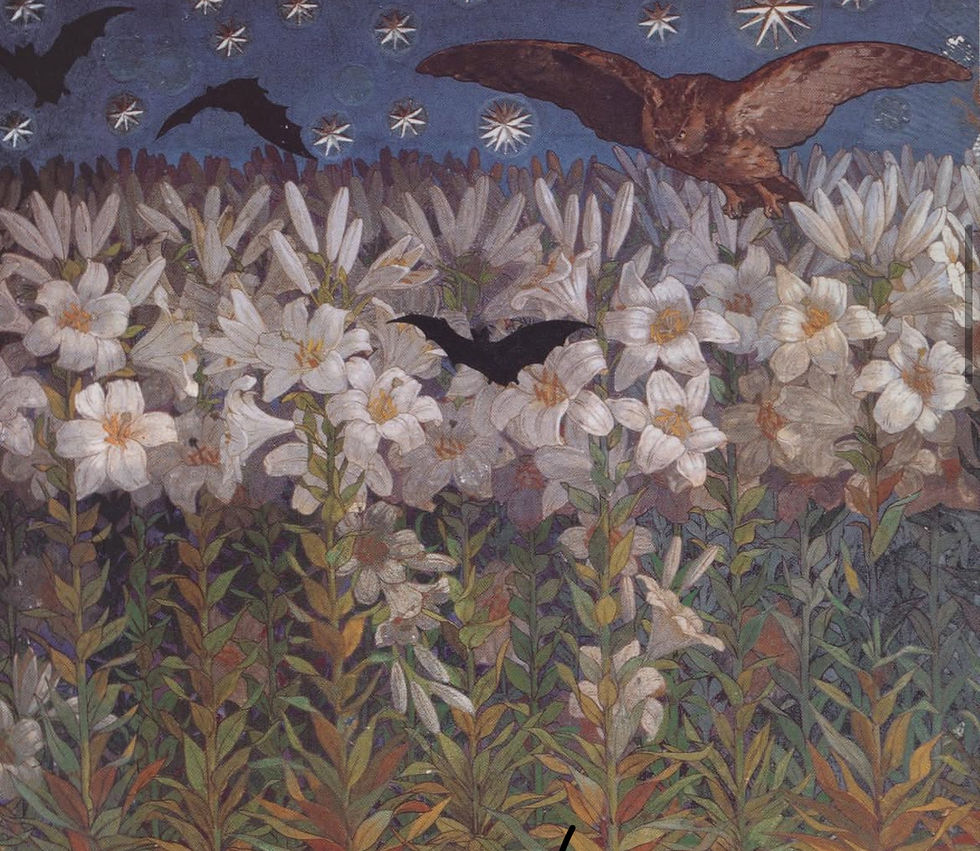
Image: Max ERNST 1891 - 1976 SANS TITRE - 1921
I remember one of the things I was struggling most as a child was the push from early days to choose a side - creative or logical? To have your parents take an interest in you by careful observation is not necessarily a bad thing especially when the intent is to help you become more authentically yourself. When somebody is watching your behaviour by helping you to be more you that, of course, is much more beneficial compared to being constantly corrected to comply with the societal norms and ideas. So the split was introduced early on to me and the comments were always there - ‘she is so good at mathematics’ - so the side I was pushed towards was clear - the rational one. The intuitive part of me clung to its creative identity over the years resisting being pushed aside each year occupying more and more of my time and eventually overtaking the rational side. Lots of movement back and forth created a lot of confusion making me unfit for either of the stereotypes. Now I am lucky I was raised in a way that allowed me to evolve this kind of thinking and taught me to pause instead of automatically accepting what was said to me and ask - does this really resonate with me? Of course there are times when that self-check can make you miss valuable criticism but at that moment it gave me the freedom to question the validity of this theory.
The split problem is not just personal but cultural too. Western education systems have often emphasised a split between what C. P. Snow (1959/1998) called ‘the two cultures’ - the sciences and the humanities. This framing has made many people feel like they must show devotion and loyalty to one way of thinking whilst neglecting the other. Yet research on cognitive development shows that creativity and logic are not only compatible but deeply interconnected. For example Kaufman and Beghetto (2009) argue that creativity emerges in many domains from the arts to scientific discovery suggesting that imagination and reasoning constantly feed into each other.
If we step back into history the great minds of Ancient Greece and the Renaissance - artists, poets, mathematicians, philosophers did not view creativity and logic as opposing things. Many excelled in both domains finding that true art is deeply informed by mathematics. In fact scholars such as du Sautoy and Darling have recently explored and articulated how mathematical structures underpin music, visual art, architecture and literature arguing that creativity and mathematical precision are mutually enriching rather than exclusive. The art has mathematical laws built into it so even though a lot of artists do it intuitively without understanding the ‘science’ behind it, some of them choose to explore the play between the two sides.
Let’s talk about sacred geometry and how it connects to divine works of art. Marcus du Sautoy delves into this in Blueprints highlighting that mathematics and art are not separate realms but rather mirror one another through structure and pattern. He reveals how artists from Mozart to Jackson Pollock are either consciously or intuitively using mathematical constructs like the golden ratio, Fibonacci sequences, symmetry, fractals and even Platonic solids in their work (du Sautoy, 2025). Since ancient Greece thinkers have conceived of the universe as crafted by a divine geometer seeing forms and symmetrical proportions as reflections of cosmic order. In the Renaissance this idea blossomed - Luca Pacioli’s Divina Proportione illustrated by Leonardo da Vinci presented the golden ratio as a principle of divine creation framing geometry as the language through which art and the divine become one (Magnaghi-Delfino & Norando, 2019). Du Sautoy invites us to reconsider the age-old divide between logic and creativity by showing how deep mathematical ‘blueprints’ manifest through musical harmonies, visual compositions, architecture and literature. In a sense sacred geometry the belief that the universe and divine creation are built upon geometric principles echoes this idea tracing back to Platonic and Pythagorean traditions where geometry was seen as the divine language of creation. Pythagoreans believed all things are numbers and applied harmonious ratios in sacred buildings like the Parthenon where proportions seem to echo a universe designed with musical precision (Adhikari, 2023; Balietti, 2020). This fusion of art and mathematics where divine beauty emerges from form, proportion and pattern feels like a conversation between the intuitive soul and the logical mind, one that I find deeply inspiring. Mathematical ‘blueprints’ give creative works both structure and soul (du Sautoy, 2025).
All of this suggests that things in nature, art and culture have rules. These are not always visible immediately and most often they are felt intuitively only. Not everybody’s mind is trained to recognise those patterns but we can feel them emotionally - when something moves or resonates with us it is likely because a sacred pattern lies beneath. Our intuition is seeking out these hidden harmonies.
We ourselves are a manifestation of infinity. Body and spirit are not separate but two expressions of the same matter - the body being a condensed version, the spirit a more expanded one. Human beings develop according to the laws of nature and the patterns we find in the cosmos are echoed in the human form. The closer something is to this harmony, the more perfect and beautiful it is perceived to be. The very fact that we seek beauty makes us in some sense artists. Some individuals are naturally gifted at making great works of art whilst others feel a calling that compels them to work not only on their technique but on themselves - ideally mind, body and spirit. Art is intuitive but intuition must be cultivated. It is tempting for the ego to take credit but the patterns that inspire us are universally available - what Jung called the collective unconscious and Rupert Sheldrake refers to as morphic resonance. Technique should not be dismissed, of course, mastery in painting, filmmaking, poetry, mathematics or astronomy requires years of effort and understanding. Yet true artistry comes not from aligning oneself with these patterns and being able to translate them into form.
Another interesting example is music’s ability to move crowds emotionally. Scientists have been studying this for decades and their findings are fascinating - some musical features are especially good at triggering emotions. Sudden shifts to an unexpected chord or key can trigger the brain with surprise and pleasure. Dissonant harmonies that finally resolve into consonance create a rush of release. Melodies that linger on the ‘wrong’ note just a little longer than expected often deliver a wave of intensity. Even the simple build-up of a crescendo primes the body for an emotional payoff. In these moments brain imaging studies show that dopamine, the same chemical linked to food, love and other pleasures is released in bursts (Salimpoor et al., 2011). What makes this even more intriguing is how closely these musical experiences echo the mathematics of sacred geometry. Consonant intervals such as octaves (2:1) and fifths (3:2) are built upon simple frequency ratios, the very same proportions that appear in nature’s geometry - in shells, flowers and galaxies. When infants prefer consonance over dissonance they may be responding to these simple mathematical relationships at a biological level (Trainor & Heinmiller, 1998). Some researchers suggest that the brain processes such intervals more efficiently because they align with natural harmonic patterns (McDermott et al., 2010). The rise and fall of tension in music reflects another sacred principle - balance between the opposites. In geometry beauty often emerges from the interplay between symmetry and asymmetry, from the perfect balance and dynamic imbalance. In music dissonance is the disturbance, the asymmetry whilst resolution restores order. Crescendos themselves resemble spirals expanding outwards, a sound-version of the Fibonacci sequence unfolding in time. This is why when a song gives you chills for no obvious reason it can feel almost cosmic. Your brain and body are reacting to universal acoustic cues and resonating with the geometry of the natural world.
So why can’t we dispel the myth of the split? My guess is that this blending of creative and rational thinking makes individuals that mastered both domains particularly powerful to communities that rely on conformity. I suspect that those who harmonise both ways of thinking are often the most dangerous and influential in the best sense of the word. They carry the potential to inspire a profound change by encouraging others to question and imagine. Unfortunately that very daring invites resistance. Societies built on commercial interests, conditioned beliefs and narrow interpretations of ‘scientific fact’ find it easier to resist thinkers who challenge it. And for this very reason we lack great leaders and influencers. Sacred geometry offers one way of seeing beyond this divide. Rooted in Platonic and Pythagorean traditions it reflects the belief that the universe is structured by divine mathematical principles.
I am not suggesting that science is flawed but our exposure to it can be limited and often filtered through power dynamics and funding biases. Whilst many wonderful discoveries and ideas do see the light of day, other valuable insights lie neglected. There is a growing movement of research that is expanding our understanding but we must remain mindful that what we see of science is often just one facet of a richer, more complex truth.
This so-called split? I think it is manmade not natural. Both history and research suggest that when these modes of thought meet, they open the way to deeper understanding and beauty. To heal this cultural split is to reclaim a fuller picture of human potential - one where art and science work together.
References
Adhikari, I. M. (2023). Golden ratio: Construction, geometry, beauty, and diversity. International Journal of Operational Research/Nepal (IJORN), 11(1). https://www.researchgate.net/publication/379888188_Golden_Ratio_Construction_Geometry_Beauty_and_Diversity
Balietti, S. (2020). The human quest for discovering mathematical beauty in the arts. arXiv preprint arXiv:2011.09861. https://arxiv.org/abs/2011.09861
Di Teodoro, F. P. (2015). Leonardo da Vinci: The proportions of the drawings of sacred buildings in Ms. B, Institut de France. Architectural Histories, 3(1), Article 1. https://doi.org/10.5334/ah.di
du Sautoy, M. (2025). Blueprints: How mathematics shapes creativity.
Kaufman, J. C., & Beghetto, R. A. (2009). Beyond big and little: The four C model of creativity. Review of General Psychology, 13(1), 1–12. https://doi.org/10.1037/a0013688
Magnaghi-Delfino, P., & Norando, T. (2019). Luca Pacioli: A friend of Leonardo da Vinci—De Divina Proportione in capital letters. In Proceedings of the 18th International Conference on Geometry and Graphics (pp. 2205–2208). Springer. https://www.researchgate.net/publication/326251584_Luca_Pacioli_A_Friend_of_Leonardo_da_Vinci_De_Divina_Proportione_in_Capital_Letters
McDermott, J. H., Lehr, A. J., & Oxenham, A. J. (2010). Individual differences reveal the basis of consonance. Current Biology, 20(11), 1035–1041. https://doi.org/10.1016/j.cub.2010.04.019
Salimpoor, V. N., Benovoy, M., Larcher, K., Dagher, A., & Zatorre, R. J. (2011). Anatomically distinct dopamine release during anticipation and experience of peak emotion to music. Nature Neuroscience, 14(2), 257–262. https://doi.org/10.1038/nn.2726
Snow, C. P. (1998). The two cultures. Cambridge University Press. (Original work published 1959)
Trainor, L. J., & Heinmiller, B. M. (1998). The development of evaluative responses to music: Infants prefer to listen to consonance over dissonance. Infant Behavior and Development, 21(1), 77–88. https://doi.org/10.1016/S0163-6383(98)90055-8

Comments