The Alchemy of Imagination
- Nov 10, 2025
- 6 min read
Updated: May 20

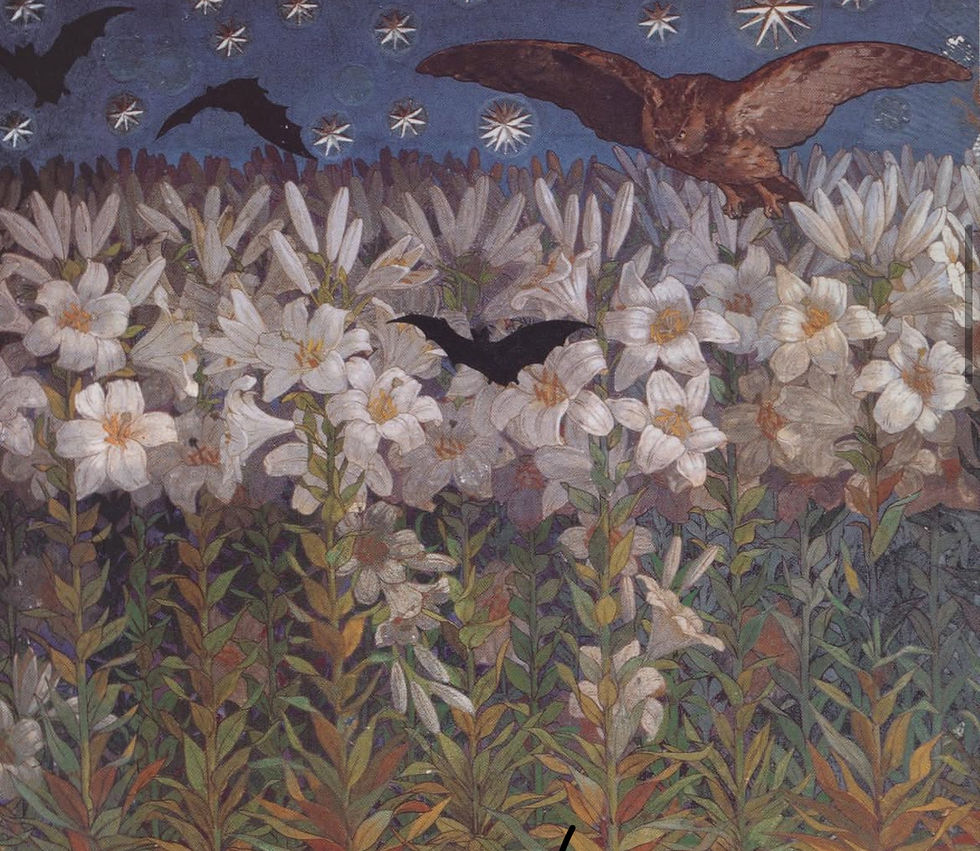
Image: Leonora Carrington Pastoral 1950
Life is as true as you believe it to be and yet this statement unsettles us. We live in a time when the work of self-development is no longer confined to esoteric circles. Neuroscience, psychology and contemplative practices increasingly converge to confirm something depth psychology has long intuited - imagination is one of the very forces by which reality takes shape.
Alchemy provides one of the richest symbolic frameworks for understanding imagination. To the medieval alchemists the transformation of base metals into gold was never merely chemical but a mirror of inner work. Jung (1968) recognised in their images of furnaces, vessels and transmutations a language of the psyche - imagination was the crucible in which shadow and light, instinct and spirit were fused into new forms. Modern neuroscience may describe this as neuroplasticity, the brain’s ability to reconfigure itself through mental imagery yet the alchemists spoke more poetically of the opus, the great work. Both point to the same truth - that imagination is the fire of transformation, the medium through which the raw materials of our psychic life are refined into wholeness.
For Jung imagination was a primary function of the psyche, a threshold into the unconscious. Through his method of active imagination he invited dialogue with inner figures, archetypes and symbolic images as if they were autonomous beings. These were not idle fantasies but transformative encounters capable of integrating shadow, anima or animus and other archetypal contents into conscious life. The imaginal was a place of healing, creativity and psychic reorganisation.
Contemporary neuroscience lends weight to this vision - mental imagery research demonstrates that the brain does not neatly separate imagination from perception. When one vividly imagines an action - striking a piano key, lifting an arm or walking through a forest - many of the same neural circuits activate as when the action is physically carried out (Pearson, Naselaris, Holmes, & Kosslyn, 2015). Imagination rehearses reality at the neural level forging pathways that can make new possibilities more likely to unfold. This is neuroplasticity at work - the brain’s capacity to rewire itself according to the images it holds.
Hypnosis provides another example of how imagination operates as lived experience. Far from stage spectacle hypnosis is a natural state of focused attention and heightened receptivity. Research shows that hypnosis can disrupt rigid automatisms of thought and behaviour opening the way to new configurations of perception and response (Oakley & Halligan, 2013; Fox et al, 2016). The suggestion that an arm is lighter than air can result in involuntary movement because the imagination when followed fully enlists the body itself. This is the psyche responding directly to symbolic language, an alchemy of image and embodiment. Neither magic nor hypnosis are opposed to science. They are both, in their essence, arts of imagination. Magic operates by engaging the symbolic dimension of reality, arranging ritual and image in such a way that the unconscious participates. Hypnosis draws upon the same principle - the psyche obeys images more readily than abstract commands. Jung understood this as the psyche’s native language. Dreams, myths and visions communicate through imaginal narratives, symbols and archetypal motifs.
Cognitive science now frames imagination within the theory of predictive processing. The brain is an active constructor of reality constantly generating models of the world and updating them through perception (Friston, 2010). What Jung named ‘creative imagination’ is mirrored here - inner images guide our interpretation of events, fill gaps in sensory input and generate possibilities for future action. Reality as we experience it is never raw, it is always filtered, coloured and shaped by belief, memory, emotion and imagination.
At the heart of this is belief - self-efficacy, the conviction that one can achieve a desired outcome, has long been shown to influence performance and wellbeing (Bandura, 1997). To imagine is to participate in it the reality unfolding. When we hold an image of integration the psyche begins to organise itself towards that image. Individuation for Jung is this alignment of conscious and unconscious through symbolic engagement. Neuroscience might call it adaptive reconfiguration of neural networks. Both offer the same truth - the images we live by shape the lives we live.
Whilst psychotherapy and medication can be invaluable there is growing concern that the cultural emphasis on external solutions may sometimes eclipse the necessity of personal engagement with the psyche. Jung emphasised the ‘work on oneself’ as central to individuation warning that healing cannot be outsourced but must arise from conscious dialogue with one’s own depths (Jung, 1954/1968). Contemporary research echoes this view suggesting that overmedication can blunt emotional processes essential for integration and growth (Moncrieff, 2008). Also studies on self-reflection and contemplative practices demonstrate that deliberate inner work such as imagery, mindfulness or active imagination can foster resilience and long-term change without the side effects often associated with pharmacological interventions (Davidson & Kaszniak, 2015). This is not to reject therapy or medicine but to recognise that imagination and self-engagement are indispensable - without them treatment risks remaining superficial addressing symptoms whilst leaving deeper psychic patterns untransformed.
To work with the self also means entering into what might be called a dialectical entanglement (I cannot remember anymore where I heard this term so I am interpreting it in my own way). Jung saw the psyche not as a static structure but as a field of opposites - conscious and unconscious, persona and shadow, masculine and feminine locked in continual tension. Healing and growth emerge by holding this tension until a new form can arise. Psychology research supports this view - dialectical processes such as the ability to tolerate contradictions and integrate conflicting emotions are linked to greater resilience and psychological flexibility (Hayes, Strosahl, & Wilson, 2012). The entanglement of opposites is therefore the very medium of transformation an just as entangled particles in physics cannot be reduced to independent states, the psyche’s oppositions are inseparable each shaping the other. To live creatively with imagination is to step consciously into this entanglement where shadow and light, fear and hope coexist and through their interplay the self unfolds.
Imagination is often trivialised as child’s play yet its power is evident across different domains - guided imagery is used in psychotherapy to heal trauma, visualisation enhances athletic performance and mental rehearsal accelerates learning (Holmes & Mathews, 2010). The Surrealists sought its raw stream through automatic writing whilst shamans and magicians have worked with imaginal symbols for millennia. To dismiss imagination is to sever ourselves from one of the psyche’s most vital functions. Imagination is not confined to the visual sense, it can be auditory, kinaesthetic, olfactory or emotional - the psyche weaves all these modalities into lived experience. To strengthen imagination is to strengthen our capacity for transformation, for reimagining the world we inhabit and the self we are becoming. To live consciously with imagination is to enter into the creative unfolding of reality itself.
References
Bandura, A. (1997). Self-efficacy: The exercise of control. New York: Freeman.
Davidson, R. J., & Kaszniak, A. W. (2015). Conceptual and methodological issues in research on mindfulness and meditation. American Psychologist, 70(7), 581–592. https://doi.org/10.1037/a0039512
Fox, K. C., Xu, M., & Wang, D. (2016). Behavioural and neural correlates of hypnosis. Neuroscience & Biobehavioral Reviews, 68, 123–141. https://doi.org/10.1016/j.neubiorev.2016.05.004
Friston, K. (2010). The free-energy principle: A unified brain theory? Nature Reviews Neuroscience, 11(2), 127–138. https://doi.org/10.1038/nrn2787
Hayes, S. C., Strosahl, K. D., & Wilson, K. G. (2012). Acceptance and commitment therapy: The process and practice of mindful change (2nd ed.). New York: Guilford Press.
Holmes, E. A., & Mathews, A. (2010). Mental imagery in emotion and emotional disorders. Clinical Psychology Review, 30(3), 349–362. https://doi.org/10.1016/j.cpr.2010.01.001
Jung, C. G. (1954/1968). The practice of psychotherapy (Collected Works Vol. 16, R. F. C. Hull, Trans.). Princeton, NJ: Princeton University Press.
Jung, C. G. (1966/1969). The structure and dynamics of the psyche (Collected Works Vol. 8, R. F. C. Hull, Trans.). Princeton, NJ: Princeton University Press.
Jung, C. G. (1968). Psychology and alchemy (Collected Works Vol. 12, R. F. C. Hull, Trans.). Princeton, NJ: Princeton University Press.
Moncrieff, J. (2008). The myth of the chemical cure: A critique of psychiatric drug treatment. Basingstoke, UK: Palgrave Macmillan.
Oakley, D. A., & Halligan, P. W. (2013). Hypnotic suggestion: Opportunities for cognitive neuroscience. Nature Reviews Neuroscience, 14(8), 565–576. https://doi.org/10.1038/nrn3538
Pearson, J., Naselaris, T., Holmes, E. A., & Kosslyn, S. M. (2015). Mental imagery: Functional mechanisms and clinical applications. Trends in Cognitive Sciences, 19(10), 590–602. https://doi.org/10.1016/j.tics.2015.08.003

Comments