The Kingdom Within and Without: Surrealist Games, Ancient Wisdom and Archetypal Pedagogy
- Nov 10, 2025
- 7 min read
Updated: May 20

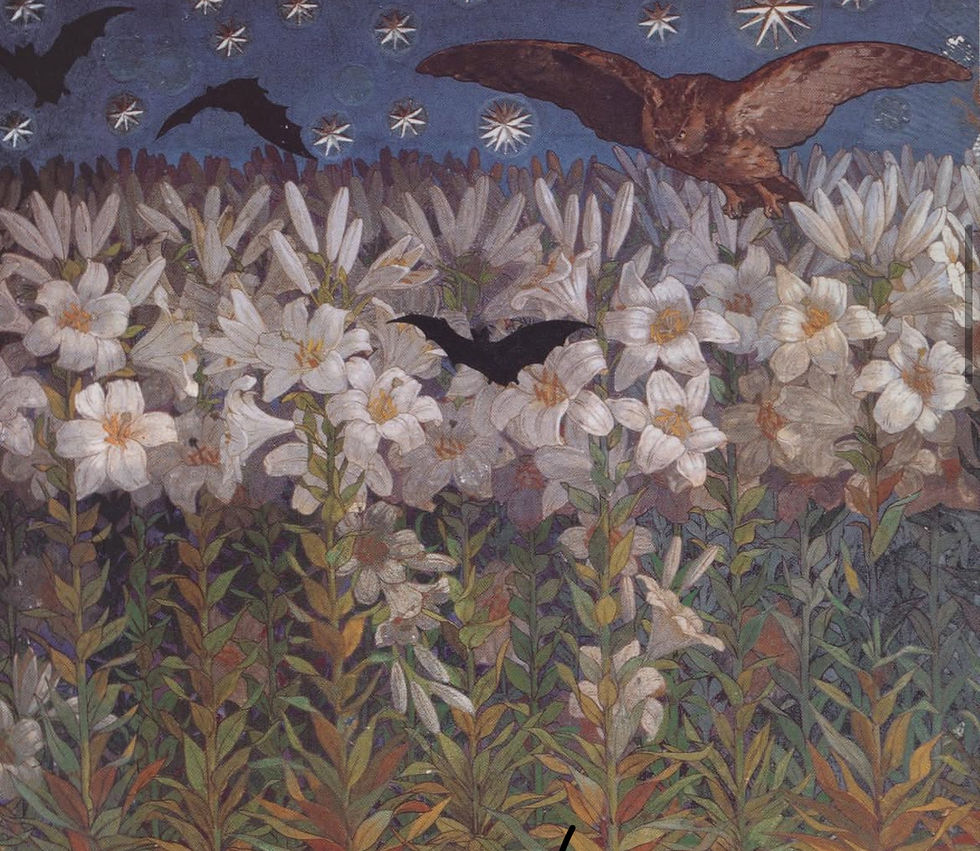
Picture: Remedios Varo, Creation of the Birds (Creacion de las aves) (1957). Oil on masonite.
‘Whoever finds interpretation of these sayings will not experience death’ (Gospel of Thomas) - a realm where meaning beyond rational language is discovered by turning inwards, reaching right down into the oldest forms of expression that speak through dreams, myths and the unconscious. Long before the first written words appeared humans were already communicating through symbols, patterns and drawings. This suggests that language evolved out of an older and more primal symbolic mode of expression. Language may be considered humanity’s best invention but symbols were our first teachers. Over time words came to dominate especially in philosophy and scientific thought where language is treated as the primary vehicle of meaning. Language, of course, has been one of humanity’s most outstanding achievements making possible scientific discovery, collective knowledge and the shared frameworks that hold societies together.
Yet those earlier symbolic forms have never disappeared, at least from our unconscious. We can still trace them in the world surrounding us as well as other realms such as dreams or the unconscious mind where shapes, images and patterns speak to us in ways that bypass words and connect directly with the most profound and ancient parts of us. Language as a means to convey deep complicated philosophical and existential questions is, as many philosophers remind us, profoundly imperfect. It provides a shared framework - rules and structures that allow society to communicate and build meaning together. However when it comes to the deepest experiences of life - love, grief, awe, the numinous - words often fail us. In those moments we return to symbols, images and gestures, to the forms of expression that reach beyond language. Some of the most primal forms such as circles, spirals and ratios are even older than humanity itself and if we believe that we hold stored memory since the Big Bang these are the forms that can give us the knowledge and secrets of the universe long before our appearance.
Many of the world’s most profound texts are written in a symbolic language that resists literal interpretation and analytical reasoning and it is this quality that has caused some of them to be neglected in modern times. Works like the Upanishads and the Bhagavad Gita speak in metaphors of battles and cosmic unity that only reveal their meaning when read inwardly (Radhakrishnan, 1994). The Tao Te Ching and the I Ching invite us into paradox and pattern yet to the overly rational mind they can seem obscure (Laozi, trans. Mitchell, 1988). The Egyptian Book of the Dead and the Epic of Gilgamesh present archetypal journeys through death, immortality and renewal but often are being dismissed as superstition (Eliade, 1963). Even within the Biblical tradition symbolic writings such as the Book of Revelation have often been marginalised or misunderstood because it does not fit the rational and doctrinal framework imposed on them (Pagels, 2003). What unites all these texts is their insistence that ultimate truths cannot be captured in direct explanation, they require imagination, intuition and symbolic perception. To modern consciousness which prioritises clarity and rationality their voices can sound strange and impossible to understand yet from a Jungian perspective this symbolic language is the native tongue of the unconscious itself (Jung, 1964). The relearning of our true nature can happen by reconnecting with the living psyche within us in a ritualistic and symbolic manner.
Lately I have been spending time with the Gospel of Thomas, one of the early Christian texts discovered near Nag Hammadi in 1945. It is composed of sayings - short and enigmatic utterances of Jesus. Very much like Koans - paradoxical riddles used in Zen Buddhism to transcend rational thought and open intuitive understanding (for example ‘What is the sound of one hand clapping?’). On the surface they may appear puzzling because they resist literal interpretation but when read symbolically they open into archetypal depth. For instance the saying ‘The kingdom is within you and it is outside you’ resonates with Jung’s idea of the Self as both within and beyond the ego (Jung, 1959/1981). Other parts talking about becoming like a child or recognising the light within are not simple moral instructions but archetypal invitations - doorways into inner transformation. In this sense the Gospel of Thomas functions like a dream and its language of paradox and image does not offer much for an analytical mind. Engaging with it reminds us that religious texts were never only rational doctrines but vehicles for symbolic imagination and psychic renewal (Pagels, 2003; Meyer, 2007). Because of the symbolic language these texts are dismissed in mainstream scientific thought as mere tales with nothing else to offer.
The unconscious does not explain itself in neat sentences, it casts symbols into our imagination. In the early twentieth century a group of artists and writers known as the Surrealists led by André Breton sought to tap directly into this symbolic stream. Influenced by Freud’s theories of dreams and the unconscious they created techniques like automatic writing and Exquisite Corpse to bypass rational thought. In these experiments when the mind slips into a particular state beyond logic - the unconscious begins to speak. For the Surrealists it was a profound discovery, they believed they had uncovered another language - one of the unconscious, composed of imagery, juxtaposition and archetypal resonance. When we engage in surrealist games we are learning to listen to the psyche in its own native tongue. Surrealism is far more than art history, it is a practice and a portal beneath logic into the unconscious language of symbols.
Jung called this practice active imagination - engaging in a conscious dialogue with the unconscious through images, fantasies or spontaneous creation. Though the Surrealists did not use this phrase, their methods echoed Jung’s ideas. Their games let the unconscious arrange images, forms and words freely. The outcomes might seem absurd to the ego yet often linger like dream residues, meaningful just beyond comprehension. This state also resembles hypnosis - a natural focused absorption much like daydreaming in which the mind becomes more open to internal imagery and suggestion. Just as hypnosis allows access to deeper layers of thought and feeling, surrealist games open a similar receptive field - a liminal space between waking and dreaming where symbols emerge freely from below the surface. Neuroscience suggests that hypnosis may reduce automatic chaining of thoughts and enhance cognitive-emotional flexibility through ‘de-automatisation’ (Fox et al., 2016).
You can experience this yourself. Sit with a pen and paper, do some breathing exercises to calm your nervous system down, trance-like focus and begin writing without censor or plan. Allow the words to flow however fragmented or strange they may appear. Later revisit them and read them as you would a dream - symbolic communication from your inner world. Alternatively gather magazines or printed images that draw you without reason and assemble a collage. What emerges will be a dream-image in visual form - a map of the psyche’s hidden terrain. You might also fold paper into sections and create your own Exquisite Corpse, drawing or writing within each fold so the prior parts remain concealed. The figure or passage you unveil will be a symbolic creature - strange but undeniably alive. Even a walk can be turned into symbolic experience - rename a tree ‘guardian’, a door ‘threshold’ and suddenly you will notice the world shifting into a dreamscape. This way the game or imagination exercise will become your mirror externalising the unconscious as your psyche projects these symbols outwards.
In a culture obsessed with reason these methods remind us that creativity, healing and meaning arise from within. Whether through hypnosis, dream-work or surrealist games the psyche continuously invites us inward. Listening in its own language - the language of symbols - allows us to reclaim a part of ourselves that have been waiting in the dark, eager to communicate.
Moreover this symbolic language holds profound implications for education. A strand of Jungian thought known as archetypal pedagogy regards learning not merely as the transmission of knowledge but as a soulful encounter with archetypes (Mayes, 2005). Archetypes are living patterns, mythic structures we carry collectively and our engagement with them in educational settings can awaken deeper growth. In the classroom, teacher and student alike may embody archetypes such as the Sage, the Trickster, the Hero. Surrealist exercises can be woven into this approach enriching education with symbolic awareness. Imagine beginning a lesson with a few minutes of automatic writing then reflecting together on what archetypal images surfaced. Or students creating dream-collages and asking - ‘which archetype is speaking here’? Teachers journaling from their side too on which archetypal roles they enact - Mentor, Shadow, Wise Old Man can deepen their reflective practice. Integrating symbolic dialogue into education is transforming it into an initiation. Archetypal pedagogy as Clifford Mayes (2005) formulates it invites us to bring the psyche’s language into the heart of teaching and learning. Imagine living in a world where this kind of practise is standard in education system.
Thus surrealism, hypnosis, active imagination and archetypal pedagogy together reveal that beneath the surface of rationality lies a symbolic order. To embrace this dimension is to recognise that learning, healing and creativity are symbolic conversations with the soul. Logic will take you from A to B but imagination can take you everywhere. In our time society leans heavily towards the left brain - towards analysis, measurement, efficiency and control, this creates a culture dominated by what Jung might call a ‘masculine’ mode of energy - rational, outward-facing and goal-driven. These qualities are valuable but when they overshadow imagination, intuition and receptivity the so-called ‘feminine’ principles we lose balance. The cost is a narrowing of vision where only what can be quantified or explained is considered real. To restore wholeness we need both - the clarity of reason and the openness of imagination.
References
Adams, M. V. (2006). The archetypal school. In P. Young-Eisendrath & T. Dawson (Eds.), The Cambridge Companion to Jung (pp. 101–118). Cambridge University Press.
Eliade, M. (1963). Myth and reality. Harper & Row.
Fox, K. C. R., Kang, Y., Lifshitz, M., & Christoff, K. (2016). Increasing cognitive-emotional flexibility with meditation and hypnosis: The cognitive neuroscience of de-automatization. arXiv, Preprint.
Jung, C. G. (1981). Aion: Researches into the phenomenology of the self (R. F. C. Hull, Trans.). Princeton University Press. (Original work published 1959)
Jung, C. G. (1964). Man and his symbols (M.-L. von Franz, Ed.). Aldus Books.
Laozi. (1988). Tao Te Ching (S. Mitchell, Trans.). Harper Perennial.
Mayes, C. (2005). Jung and education: Elements of an archetypal pedagogy. R & L Education.
Meyer, M. (2007). The Gospel of Thomas: The hidden sayings of Jesus (2nd ed.). HarperOne.
New World Encyclopedia. (n.d.). Automatic writing in therapy. In Automatic writing. Retrieved from New World Encyclopedia.
Pagels, E. (2003). Beyond belief: The secret Gospel of Thomas. Random House.
Radhakrishnan, S. (1994). The Principal Upanishads. HarperCollins.

Comments